
The following work might be emotionally challenging since it portrays and discusses systemic racism, white privilege and enslavement. Please consider your well-being when engaging with it.
CASA DE FAMíLIA (Family Home)

Through the trajectory of a bottle that traveled among my family’s belongings I trace the itinerary of our migration during several relocations along the axis of the Atlantic Ocean. After almost 40 years in Brazil, this bottle would absurdly return to the US coast once again, as shown on the shipping documents listing our family belongings in 2012.

My mother's handwritten list of our family's belongings shipped to the United States in 2012.
When this syrup bottle was purchased in 1974, it was adorned with a bow that matched the kitchen curtains of the apartment of my newly-wed parents; For my mother, it evoked her childhood memories, when she immigrated from Brazil to America with my grandparents in 1946. This bottle represented breakfast on Saturday mornings, when my grandmother served warm pancakes doused with syrup. For the Black population in this country it is one more symbol of systemic white-supremacy and racism in The United States.
Even though “Mrs. Butterworth” syrup bottles are a diminishing representation of Black women, the commercialization of this racist figurine wouldn’t be suspended until 2020. An outcry for racial justice and equality swept the country after the brutal police murder of George Floyd that year. Only then, stereotypical representations and racial prejudice against people of color, that has been part of the iconography of food products for generations of Americans, were deemed inappropriate and unacceptable by society, and therefore no more a source of commercial value to manufacturers.
To represent this gradual veering from societal racist views still encased in glass, I created a sequence of close up shots inspired by the famous 1972 artwork by Betye Saar titled: “The Liberation of Aunt Jemima”. I hope this image evokes a lucidity of self-awareness, resilience, and equal racial representation being claimed by people of color in America and around the world, in the face of systemic and secular racial oppression.
“Her skin is like dusk on the eastern horizon,
O cant you see it, O cant you see it,
Her skin is like dusk on the eastern horizon
… When the sun goes down.
- Jean Toomer, Cane (1923)

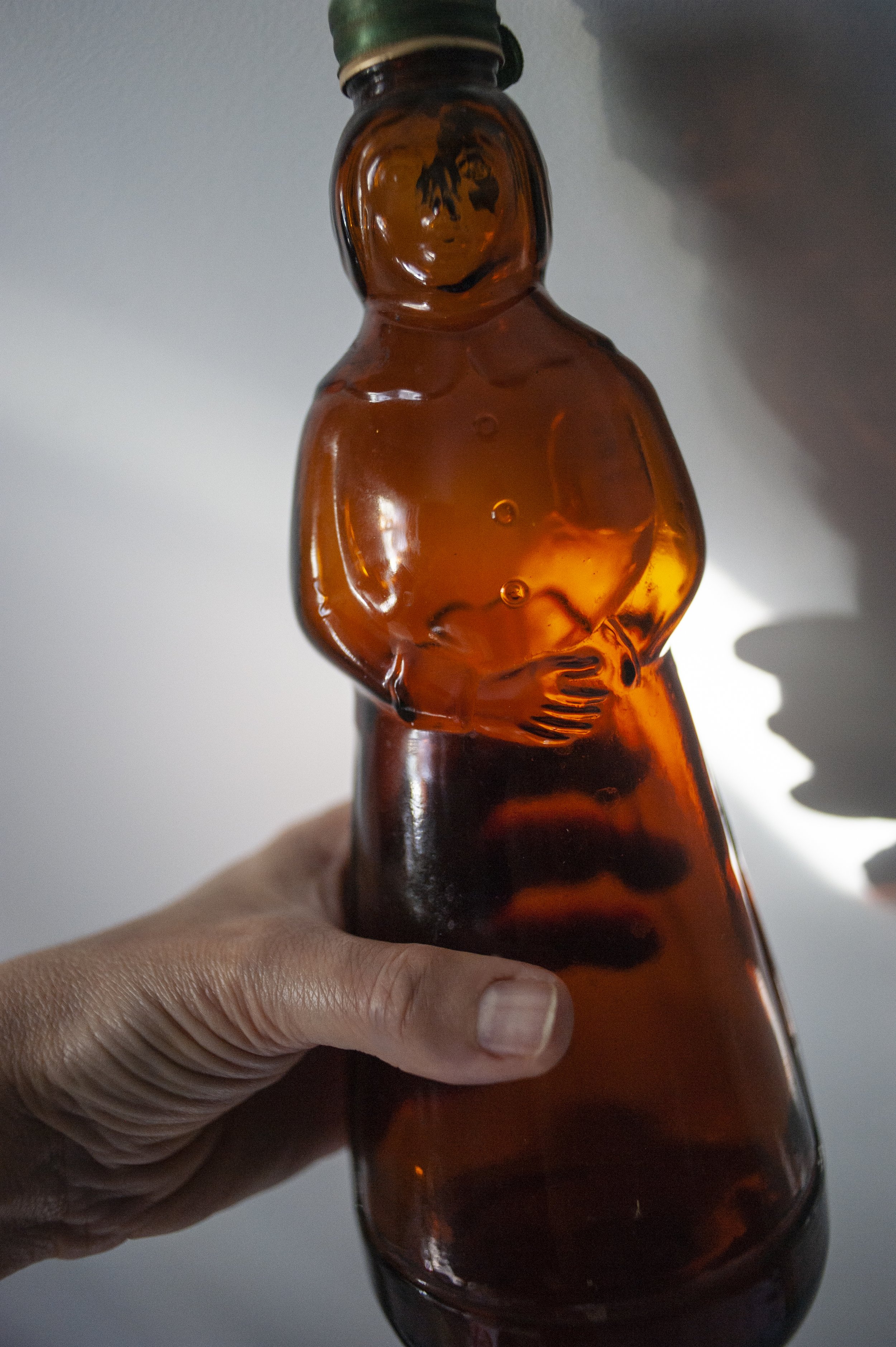
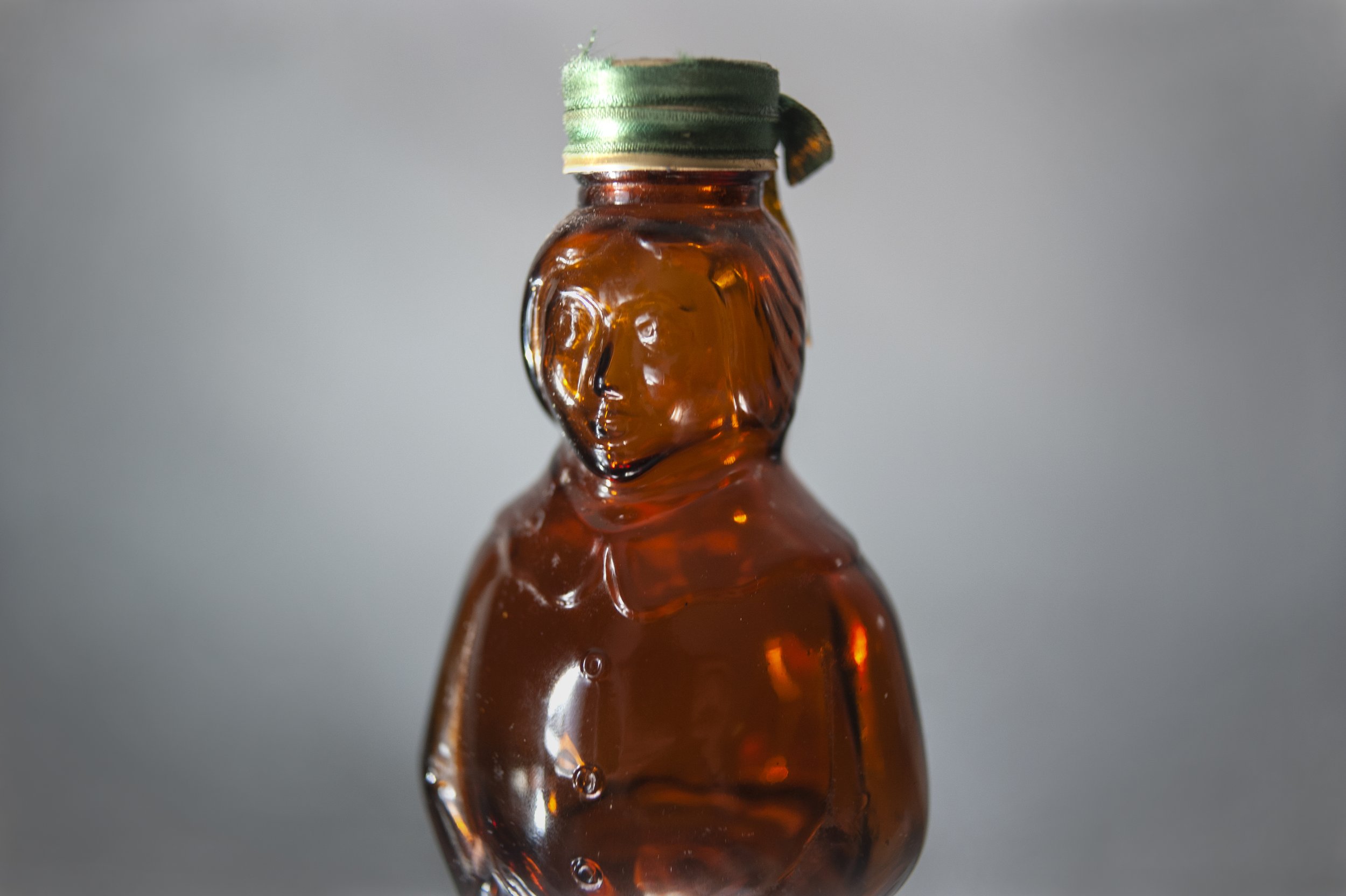


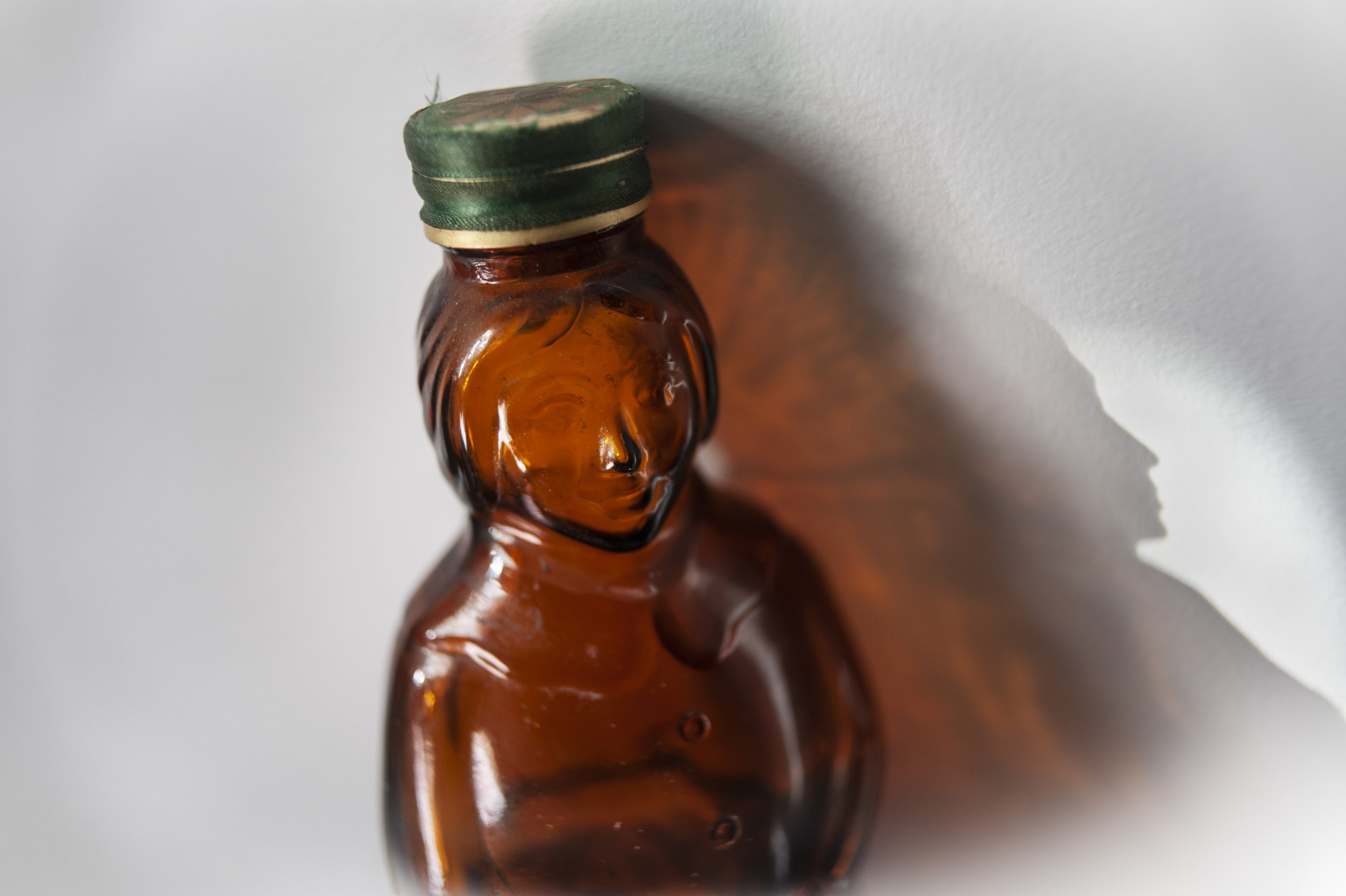
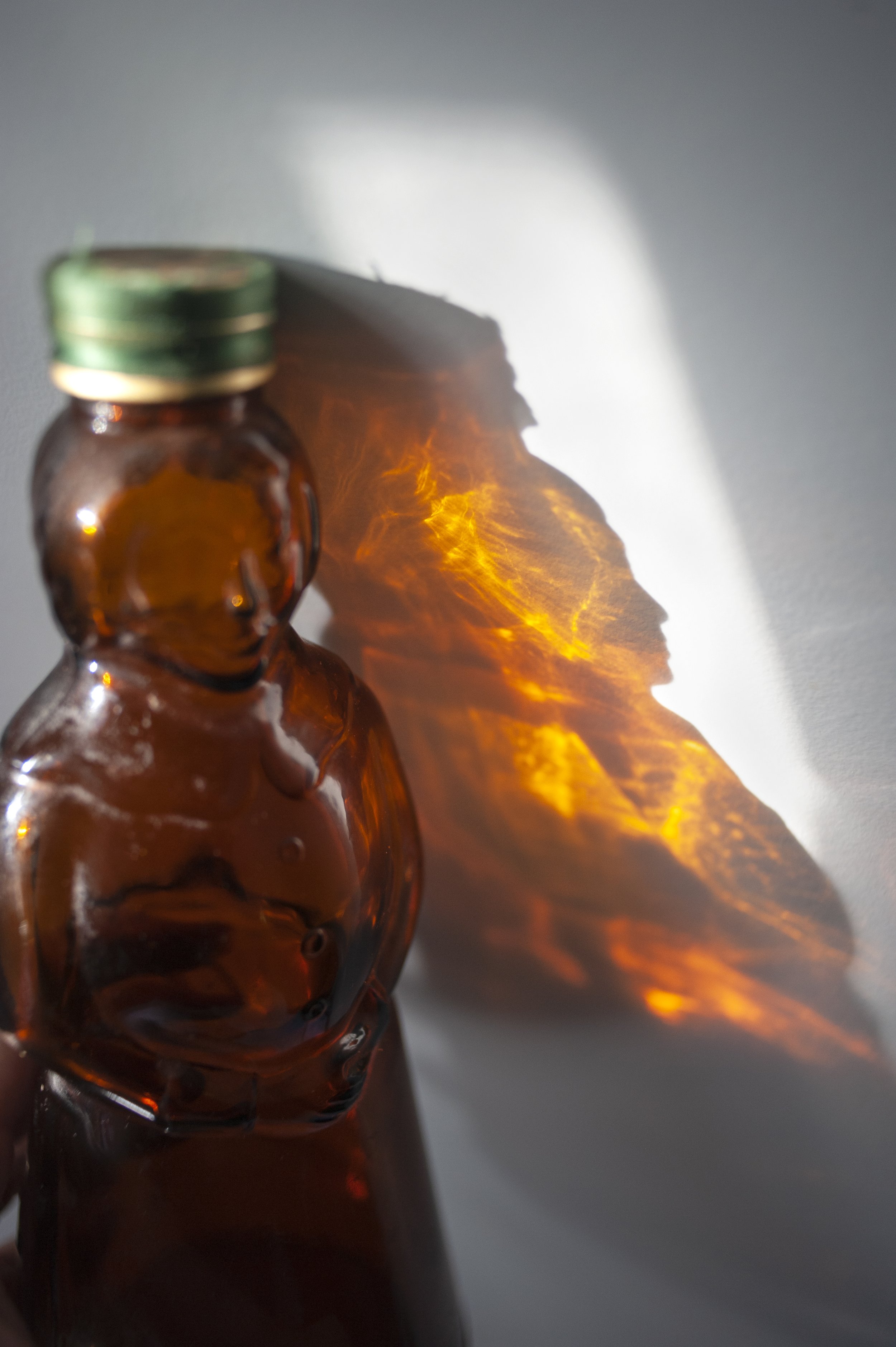
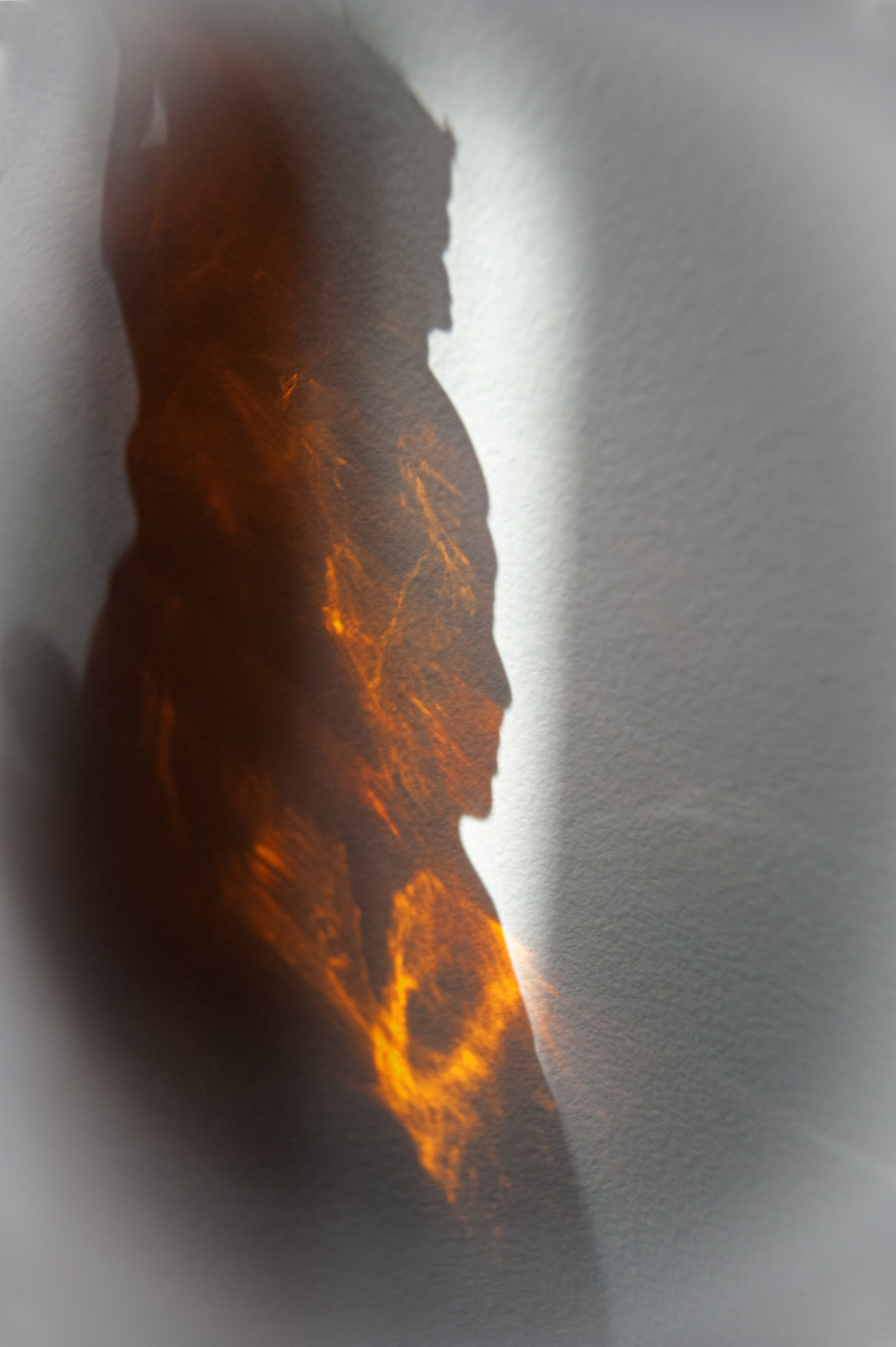
Photo series “Family Home” depicting details of a syrup glass bottle, decorated with a bow by my mother’s hand circa 1972.
Texto em Português disponível aqui.
Once this American caricature figurine of a black servant was transported to Brazil in my family’s belongings it didn’t lose it’s offensive meaning but became doubly insulting since it became a glass replica of the service workers which are to this day, an integral part of the home setting of a typical Brazilian middle-class family.
The American “Mammy” stereotype represented by this bottle once imported into the Brazilian social construct serves as a mirror of the Brazilian domestic worker: subservient to white women, working in their homes and taking care of their children. “She is treated like family” is a common saying frequently used as an excuse and denial of the unfair treatment of domestic workers and encapsulates the systemic white privilege in Brazilian society.
“This image of the Black woman as a ‘mammy’ has been serving as a social control of ‘race,’ gender and sexuality. It is a controlling image which confines Black women to the function of the maternal servant, justifying their subordination and economic exploitation. The ‘mammy’ represents the ideal Black female relationship to whiteness: as loving, nurturing, reliable, obidient and devoted servant, who is loved by the white family.”
- Grada Kilomba, Plantation Memories
Almost 6 million domestic workers, predominantly female and Black, are estimated to work at a “casa de familia”, making Brazil the country with the largest workforce of servants in the world. Demands for proper compensation and labor rights is met with resistance and entitlement by the white Brazilian elite. The sustaining disregard of domestic worker’s rights while fulfilling the comforts of white privilege is a modern inheritance of slavery. A withholding of deep-seated racism, classism, sexism and racial-inequality of Brazil’s colonial past - the last sovereign nation to abolish slavery in the Americas.
Unfortunately, my family was not an exception, and throughout the decades we’ve lived in Brazil, domestic workers sporadically worked as maids for my family - most of them of African descent. But we were probably the only family that inexcusebly displayed this bottle in the kitchen of each of our places of residences, right next to the service area where a servant’s quarters* (quartinho de empregada) a small room designated for living-maids was located.
*Spaces architecturally designed to accommodate domestic servants working in family homes. They are a symbol of inequality and systemic social segregation in Brazil. Since the COVID-19 pandemic, this practice is being finally abandoned, since positions for maids to permanently reside in a family home are being replaced by day workers.
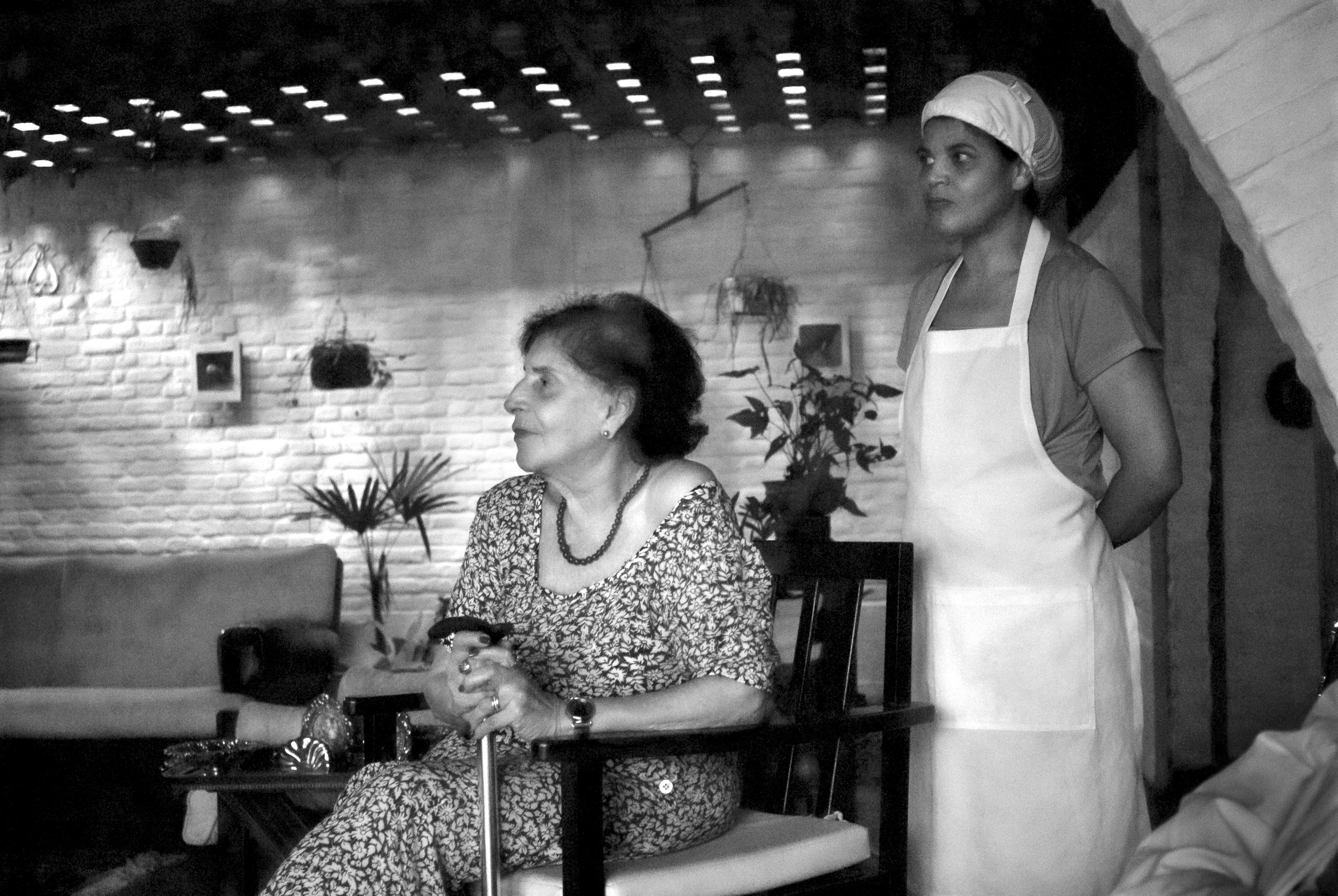
A domestic worker in a family home in Belo Horizonte, Brazil. Photo by Jennifer Cabral (2009)
“…The table was set. Coffee, biscuits and pão de queijo, the regionally famous yucca bread were served. The maid was standing by and waiting. I am the only one who seems to notice and acknowledge the maid’s constant presence. “Why don’t you sit down, have a cup of coffee, and eat some pão de queijo?”- I dared to ask only in my mind. I quickly avert the maid’s eyes in embarrassment. But as everyone else in the room, I go right back to ignoring her - as I was taught to do; as they were told to do; as we continuously, pretentiously and inexcusably choose to do…”
Excerpt from the photo essay: “This House is not yours”. Complete essay by Jennifer Cabral can be seen here.

The overdue removal of this bottle from my possessions was followed by a need to understand what matriarchal legacy had been passed down to me, and what I had chosen to carry on. In this search, I mapped the locations of each family home where this offensive and painful bottle had been displayed. I encountered coordinates that traced a fluctuation of wealth, identity and power my family had experienced in between Brazil and the United States as an immigrant family.
To represent the multiple relocations of my family in which this bottle was packaged, transported and displayed, I demarcate the coordinates of each of the family homes with bottles of honey*. By replacing this harmful and painful figurine, and leaving bottles of honey as a vestige of its presence, I create a sort of offering acknowledging violations of women’s rights experienced within the private spaces of the Brazilian family home.
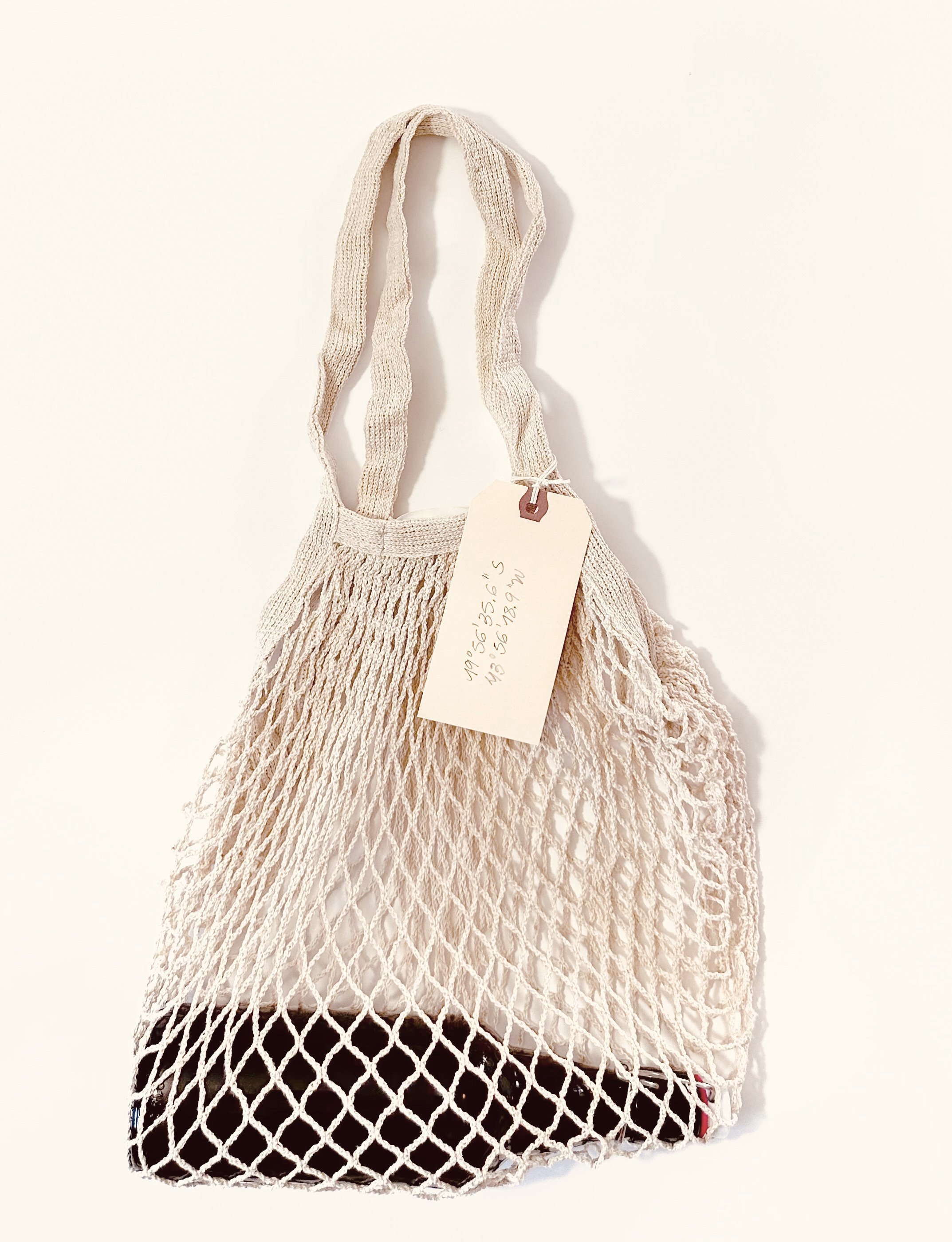
Coordinates along the Atlantic Ocean axis where my matriarchal lineage resided:
- - - - - - - - - - - - - - MRS. BUTTERWORTH SYRUP BOTTLE REMOVED FROM THE FAMILY BELONGINGS (2023)
40°15'34.2"N 74°44'02.9"W |New Jersey (2012)
19°56'12.2"S 43°58'46.0"W |Minas Gerais (1998)
19°56'27.1"S 43°56'54.5"W |Minas Gerais (1979)
19°56'35.6"S 43°56'18.9"W |Minas Gerais (1978)
23°39'23.8"S 46°31'43.4"W |São Paulo (1975)
42°31'24.2"N 83°06'11.2"W |Michigan (1974)
- - - - - - - - - - - - - - - MRS. BUTTERWORTH SYRUP BOTTLE PURCHASED (1974)
23°39'37.3"S 46°31'33.2"W |São Paulo (1972)
40°44'40.9"N 73°53'00.3"W |New York (1970)
40°45'22.8"N 73°52'30.9"W |New York (1969)
40°44'40.9"N 73°53'00.3"W |New York (1960)
40°45'23.2"N 73°49'19.3"W |New York (1958)
40°34'18.0"N 74°08'46.1"W |New York (1948)
40°34'29.5"N 74°07'41.7"W |New York (1946)
22°54'47.6"S 43°14'34.2"W |Rio de Janeiro (1940)
22°54'45.9"S 43°14'31.6"W |Rio de Janeiro (1939)
22°54'53.1"S 43°13'56.6"W |Rio de Janeiro (1935)
22°49'50.2"S 43°17'23.5"W |Rio de Janeiro (1926)
8°03'58.4"S 34°52'45.9"W |Pernambuco (1911)
- - - - - - - - - - - - - - OPERATION OF SUGAR CANE PLANTATIONS IN PAUDALHO, PERNAMBUCO (ca. 1900’s)
8°40'45”S 35°26’00”W |Engenho Santa Rita (1894) *
08°27'55,69" S · 35°02'59,18" |Engenho Água Fria (1894) *
7°54'22.3"S 35°07'01.9"W |Engenho Mussurepe (1881) *
8°01'36.4"S 35°09'30.9"W |Engenho Tapacura *
8°00'15.8"S 35°06'59.2"W |Engenho Bela Rosa *
8°03'14.4"S 35°06'20.2"W |Engenho PixaÓ (1860) *
* Approximated coordinates

But, as I expanded this tracing of my family’s residences beyond the northeast of the United States and the privileged neighborhoods of a modern Brazil, I arrived at latitudes once reigned by sugar cane plantations in the northeast of Brazil. These demarcations become records, hand-written by my own hands, that for decades of the 19th century, our family home and the “master’s house” were inexcusably one.
I use these demarcations of coordinates of sugar cane plantations to admit and acknowledge the matriarchal line of my family sustained the practice of slavery. I only dare to leave vestiges of emptiness and voids represented by woven sacks.
By using bags used to carry supplies from a supermarket where the original syrup bottle was purchased I interwove the practices of the past that are still carried in the present.
“Slavery, colonialism and everyday racism necessarily contain the trauma of an intense and violent life event, (…) the ability to find symbolic equivalents to represent and discharge such a violent reality becomes rather difficult.”
- Grada Kilomba, Plantation Memories (2008).

Coordinates of the Mussurepe Sugar Cane Plantation in Pernambuco, Brazil.
References:
Kilomba G. (2019). Plantation memories : episodes of everyday racism (5th ed.). UNRAST-Verlag.
Mask D. (2020). The address book : what street addresses reveal about identity (First). St. Martin's Press an imprint of St. Martin's Publishing Group.
Mintz, S. W. (1986). Sweetness and power. Penguin Books.
Ribeiro, D. (2020). Lugar de Fala. Sueli Carneiro.
Schwarcz, L. Moritz, & Becker, E. M. B. Brazilian authoritarianism : past and present. .
Toomer, J. (1993). Cane. New York, Liveright.
PEC das domésticas 10 anos depois: 'só queria que tratassem melhor a gente'. Fenatrad. (n.d.). Retrieved April 9, 2023, from https://fenatrad.org.br/2023/04/03/confira-materia-do-uol-sobre-a-situacao-da-categoria-apos-dois-anos-da-pec-das-trabalhadoras-domesticas-pec-das-domesticas-10-anos-depois-so-queria-que-tratassem-melhor-a-gente/
Projeto Querino. projeto Querino. (2023, February 7). Retrieved April 23, 2023, from https://projetoquerino.com.br/
AMERI_CANA
CASA DE FAMÍLIA is part of a series of works called AMERI_CANA where I explore spaces between myth and reality, tales and memory, history and fables. In passed down stories, the unfinished tracings of the diaspora of multiple generations leaves gaps that welcome the imagination and delusional fantasies of identity, while historical documents eliminate any minimization of our ancestral colonial roles - from the Brazilian northeast to the American northeast - From sugarcane to a dream of America.